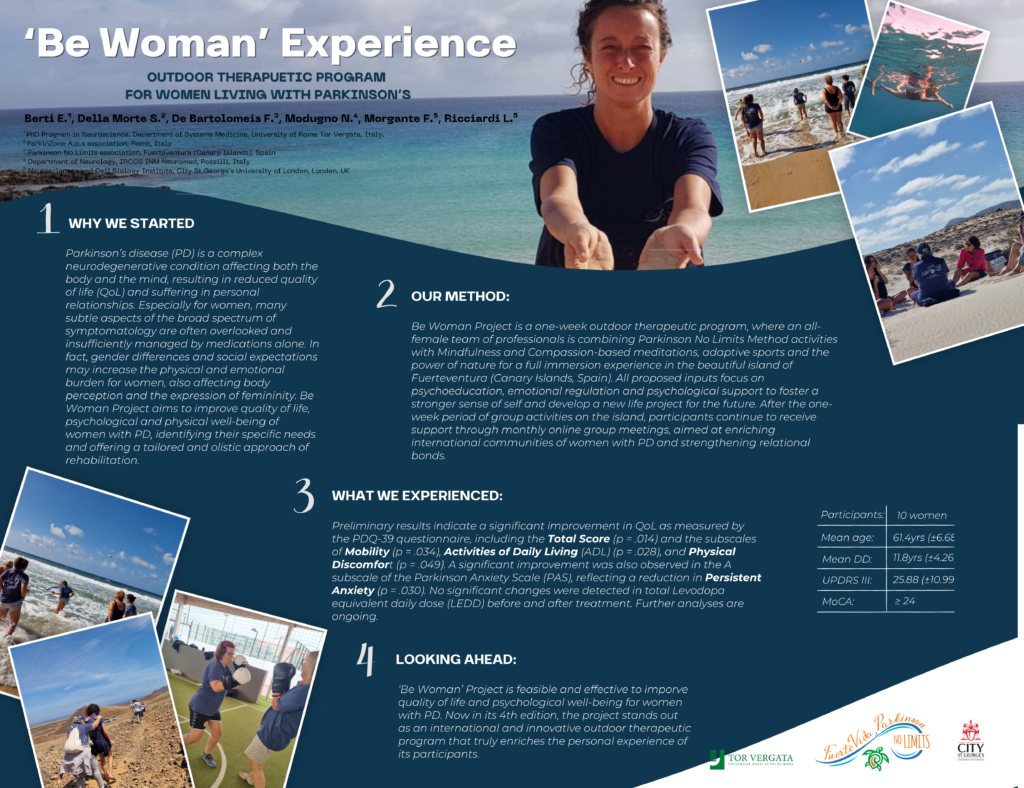


Understanding Parkinson’s Disease in Women
Only in recent years has the scientific literature, following more rigorous clinical observation, begun to highlight the true differences in the manifestation of Parkinson’s disease (PD) in women compared to men. This holds true not only for the clinical features and symptoms that develop over the course of the disease but also at the organic, neurobiological, and pharmacokinetic levels.
Indeed, it is now known that women, although slightly less prone to developing the condition than men, exhibit more prominent tremoric symptoms and a higher percentage of developing early motor complications, along with a greater incidence of mood disorders such as depression and anxiety. At the pharmacokinetic level as well, women demonstrate a heightened response to levodopa, necessitating lower or more personalized dosages. These differences, together with many others that still remain insufficiently defined by science but are nevertheless perceptible in routine clinical practice, primarily necessitate greater attention from the perspectives of scientific research and therapy, as well as rehabilitation and care.
The “Be Woman” Therapeutic Retreat
For this reason, we decided to offer a unique, tailor-made rehabilitation program for women with PD who, whether affected at a young or more advanced age, find themselves needing to redefine their life context, daily routines, and personal relationships.
The therapeutic retreat named “Be Woman” follows the model of the therapeutic retreat for individuals with PD called “Fuerte4Parkinson”, already established by the FuerteVida Parkinson No Limits Association on the island of Fuerteventura (Canary Islands, Spain). However, this outdoor therapeutic experience is specifically designed for women with PD and delves deeper into those psycho-emotional and relational aspects in which women are typically immersed and which, due to stigma and multiple cultural biases, further burden their rehabilitative journey.
A Tailored Outdoor Methodology
Specifically, the implemented methodology follows a protocol designed to alternate periods of intense physical activity with phases of cool-down, combined with exercises aimed at increasing awareness and promoting emotional well-being.
- Aquatic Sports: Surfing, kitesurfing, stand-up paddleboarding, sailing, and swimming. In general, these activities are repeated at least twice over the course of the therapeutic retreat, representing the moments of greatest physical exertion and concentration, while combining coordination exercises and muscle strengthening.
- Non-Aquatic Sports (Land-based): Practiced both outdoors and indoors, these include non-contact boxing, Pilates, yoga, and Tai Chi. These disciplines are also repeated at least twice during the therapeutic retreat and represent moments focused on muscular control, stretching, and relaxation, allowing participants to refine proprioception and coordination.
- Artistic and Recreational Activities: Repeated at least twice during the retreat, these include painting on objects, body painting, underwater painting, music-making in nature and/or using local instruments, dance, biodance, and sensory stimulation activities.
- Mindfulness and Psycho-emotional Support: Throughout the entire therapeutic retreat, each day begins and ends with meditative Mindfulness and Compassion-based practices, psychoeducational sessions, and group circle time, ensuring psycho-emotional support throughout the entire journey.
All sports activities, particularly the aquatic ones, are conducted by qualified and trained personnel tailored to the specific needs of individuals with PD. Furthermore, these activities may be affected by weather conditions and are therefore subject to rescheduling based on atmospheric conditions to ensure safety at all times.
An All-Female Professional Team
The team of professionals supporting the participating women is entirely female, and we firmly believe in the synergy of sports, artistic, and psychological activities to shake the individuals, gently guiding them out of their comfort zone toward a more functional mode of coping and management of their residual resources. Indeed, the psychological work is deep and therapeutically oriented, enhancing awareness through the practice of Mindfulness and Compassion-based techniques.
Preliminary Results and Impact
Preliminary results from the therapeutic retreat demonstrate significant improvements in quality of life (QoL), as assessed by the PDQ-39 questionnaire. These include enhancements in:
- Total Score: (p = .014)
- Mobility: (p = .034)
- Activities of Daily Living: (p = .028)
- Physical Discomfort: (p = .049)
Additionally, the A subscale of the Parkinson Anxiety Scale (PAS) showed a notable reduction in persistent anxiety (p = .030), while no significant changes were observed in the total Levodopa Equivalent Daily Dose (LEDD) before and after treatment. Further analyses are currently underway to explore these findings in greater depth.
These preliminary results demonstrate that the “Be Woman” project is feasible and effective in improving quality of life and psychological well-being for women with PD. Now in its 4th edition, the project stands out as an international and innovative outdoor therapeutic program that truly enriches participants’ personal experiences, while also emphasizing aspects of femininity and relational dynamics.
Poster n. P15.06 presented at the World Parkinson Congress in Phoenix (WPC2026)