

An International Survey disclosing possible self-image misperception and gender disparities.
The Impact of Parkinson’s Disease on Dressing and Daily Living
Parkinson’s disease manifests a broad spectrum of symptomatic challenges, including bradykinesia, rigidity, resting tremor, and postural instability, which can profoundly disrupt the activities of daily living (ADL). These motor deficits are particularly evident in fine motor tasks such as dressing, where patients can struggle with buttoning, zipping, and manipulating clothing due to impaired dexterity, slowed movements, or even freezing episodes that exacerbate frustration and dependency.
The personal and communal act of dressing, intimately tied to identity, autonomy, and social presentation, might serve as a clear indicator of disease progression: as symptoms increase, patients often opt for more adaptive, loose-fitting garments to circumvent physical barriers, inadvertently signaling their decline while underscoring the interplay between individual agency and communal perceptions of disability.
In addition to the physical and psychological distress arising from restricted fashion and clothing choices necessitated by symptom progression, there is a prevalence of self-image misperception phenomena that warrant particular attention. This interoceptive dimension of self-image can be increasingly compromised as the disease advances, disrupting cognitive and psychological brain nuclei that underpin one’s personal relationship with the body. This area remains largely underinvestigated, leaving a substantial gap that ultimately blocks patients’ ability to achieve a balanced and accurate self-perception.
An International Survey to Bridge the Gap
We launched this international online survey to further investigate these phenomena, hoping to enable both the scientific community and the fashion industry to better understand the daily struggles and challenges faced by people with Parkinson’s disease in the seemingly simple yet essential task of getting dressed.
Using Likert-scale, open-ended, and multiple-choice questions, we assessed patients’ dressing difficulties, pointing to specific problematic clothing items while exploring both bottom-up and top-down research approaches, as well as potential gender differences and disparities.
Note on Methodology: We acknowledge that this survey exhibits a cultural bias due to its binary gender framework (male/female). Although we recognize the critical importance of amplifying the voices of all individuals, regardless of their unique sexual orientation and gender identity, we were unable to implement adequate differentiation in this version.
Survey Demographics and Methodology
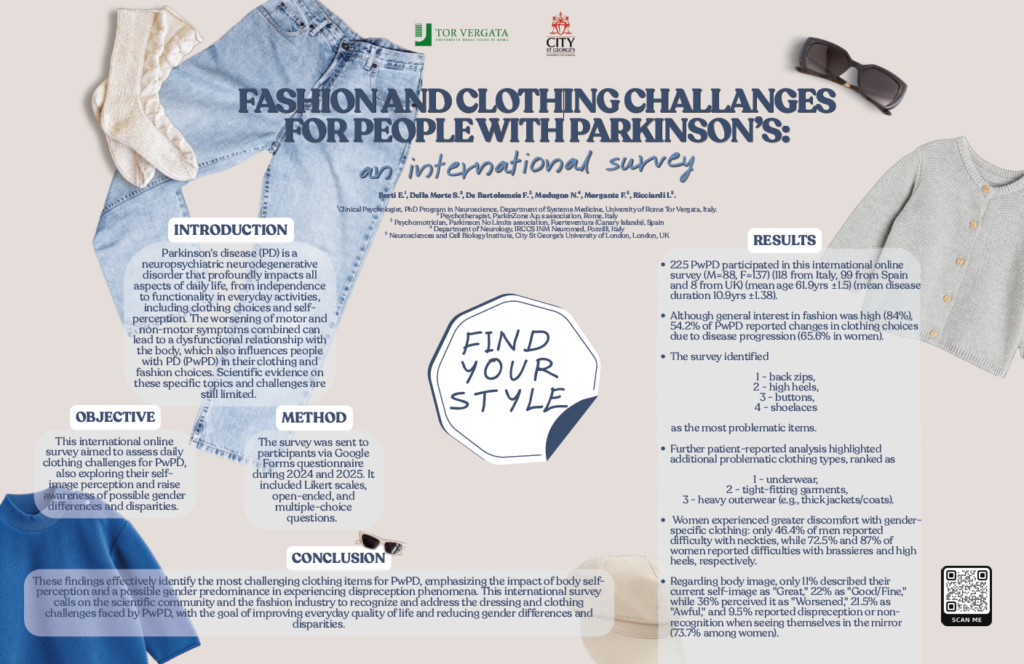
The results revealed robust participation, with 225 individuals with Parkinson’s disease completing this international online survey (88 males, 137 females), predominantly from Europe and the UK:
- Italy: 118 participants
- Spain: 99 participants
- UK: 8 participants
The sample had a mean age of 61.9 years (±1.5) and a mean disease duration of 10.9 years (±1.38). Recruitment is ongoing in Africa to broaden the scope and provide a more comprehensive assessment of these challenges.
Key Findings: Changing Habits and Problematic Clothing
Although general interest in fashion was high (84%), 54.2% of respondents reported mild to drastic changes in clothing choices due to disease progression (65.6% of those answers were from women).
Top-Down Research Results
From a top-down research approach, the survey effectively identified four items as the most difficult to wear for people with Parkinson’s, as follows:
- Back zips
- High heels
- Buttons
- Shoelaces
Patient-Reported Challenges (Bottom-Up)
Further patient-reported analysis (bottom-up research approach) highlighted additional problematic clothing types, ranked as follows:
- Underwear
- Tight-fitting garments
- Heavy outerwear (e.g., thick jackets/coats)
Gender Disparities in Clothing Discomfort
When addressing gender-specific clothes, women experienced greater discomfort than men. For example, while 46.4% of men reported difficulty with neckties, a staggering 72.5% and 87% of women reported difficulties with brassieres and high heels, respectively.
Body Image and Self-Misperception
Regarding body image and its interoception, the survey revealed concerning data about how participants view themselves:
- 11% described their current self-image as “Great”
- 22% as “Good/Fine”
- 36% perceived it as “Worsened”
- 21.5% as “Awful”
These results indicate a higher percentage of negative self-image among people with Parkinson’s. Furthermore, 9.5% of participants reported misperception or non-recognition when seeing themselves in the mirror. Strikingly, this score levels up to 73.7% among women. In particular, this latest finding underscores the high frequency of body misperceptions and self-image disturbances among individuals with Parkinson’s disease, particularly affecting women.
Conclusions and Call to Action
This result may stem from a combination of multiple factors, all equally significant and impactful on the quality-of-life outcomes for individuals with neurodegenerative diseases. The neurodegeneration itself, along with social stigma and gender roles—particularly for women—can exacerbate these symptoms and undermine a healthy, balanced relationship with one’s self-image. We know this relationship often manifests through clothing choices, further highlighting the critical need for market-available options tailored to diverse needs.
To our knowledge, these findings effectively identify the most challenging items for people with Parkinson’s, emphasizing the impact of body self-perception and a possible gender predominance in experiencing misperception phenomena.
This international survey calls on the scientific community and the fashion industry to recognize and address the dressing and clothing challenges faced by people with Parkinson’s, with the goal of improving everyday quality of life and reducing gender differences and disparities.
Poster n. P17.06 presented at the World Parkinson Congress in Phoenix (WPC2026)