

The Role of Complementary Therapies in Parkinson’s Disease
Parkinson’s disease (PD) is a chronic, progressive neurodegenerative disorder primarily affecting the world’s aging population, with cases emerging at younger ages and posing new challenges for preventive and interventional strategies in the scientific community. No cure exists to date, though treatments span from options like oral levodopa to advanced ones such as infusion therapies and deep brain stimulation (DBS) neurosurgery.
Recent scientific research pairs standard pharmacotherapy with diverse complementary therapies, including physical, artistic, recreational, and psycho-educational activities. These effectively rehabilitate lost functions, boost well-being, and elevate the quality of life for those with PD. Activities like sports, nature immersion, psychological engagement, or artistic expression are especially popular and encouraged, supporting motor, cognitive, and emotional recovery across the disease’s long course or in its final stages, alongside routine pharmacotherapy and hospital physiotherapy.
These activities, coupled with a generally healthy lifestyle, are also strongly recommended as preventive factors against disease onset and as promising disease-modifying agents, without the side effects associated with pharmacotherapy. Numerous sports disciplines are currently employed for the rehabilitation of these patients, ranging from Pilates and Feldenkrais to Tai Chi and Yoga. The same applies to artistic and recreational activities such as dance, theater, singing, and creative writing. Finally, psychological approaches—including psychological support and psycho-education, psychotherapy, and Mindfulness techniques—are among the most effective strategies to alleviate non-motor symptoms typical of PD, such as anxiety, depression, obsessiveness, cognitive decline, and even psychosis.
A Holistic and Transformative Rehabilitative Approach
In an era of growing awareness of the beneficial impact of these activities and an ever-expanding array of offerings from sector professionals, we aimed to develop a holistic, comprehensive, multidisciplinary, and truly transformative rehabilitative approach, addressing both physical and psychological dimensions.
- Sail4Parkinson (Italy): For over 10 years, the ParkinZone Association, led by neurologist Dr. Nicola Modugno, has organized outdoor sports and psycho-educational experiences using sailing techniques amid the stunning Sardinian landscape.
- Fuerte4Parkinson (Spain): In synergy with this initiative, the FuerteVida Parkinson No Limits Association, led by Francesca De Bartolomeis and Loris Pugliese, arranges therapeutic weeks in the breathtaking setting of Fuerteventura (Canary Islands), employing surfing techniques and a psychomotor approach.
Together, these experiences unite the expertise of highly qualified professionals who deliver treatments to both patients and caregivers, enhancing motor, emotional, and contextual dimensions.
The Clinical Perspective and the Outdoor Protocol
The decision to design a therapeutic retreat incorporating both motor input (through aquatic and non-aquatic sports) and psychological input (through practices based on different psychotherapeutic approaches, Mindfulness, and Compassion techniques) was grounded in an emerging clinical perspective. This perspective suggests that intensive experiences in outdoor settings may effectively stimulate the rehabilitation process in patients, especially those with PD.
PD is characterized by a highly distinctive clinical profile for each patient, along with a combination of symptoms that affect every sphere of daily life and the individual’s inner world. Initiatives such as “Sail4Parkinson” and “Fuerte4Parkinson” represent new frontiers in psychomotor rehabilitation for PD, offering not only an innovative care model but also a springboard for social engagement for both patients and caregivers, addressing quality of life in a truly comprehensive manner.
The Methodology and Activities
The implemented methodology follows a protocol designed to alternate periods of intense physical activity with phases of cool-down, combined with exercises aimed at increasing awareness and promoting emotional well-being.
- Aquatic Sports: Surfing, kitesurfing, stand-up paddleboarding, sailing, and swimming. These are repeated at least three times over the course of the retreat, representing the moments of greatest physical exertion and concentration, combining coordination exercises and muscle strengthening.
- Non-Aquatic Sports (Land-based): Non-contact boxing, Pilates, yoga, and Tai Chi. Repeated at least three times, these represent moments focused on muscular control, stretching, and relaxation, allowing participants to refine proprioception and coordination.
- Artistic and Recreational Activities: Repeated at least twice, including painting on objects, body painting, underwater painting, music-making in nature and/or using local instruments, dance, biodance, and sensory stimulation activities.
All sports activities, particularly the aquatic ones, are conducted by qualified and trained personnel, tailored to the specific needs of individuals with PD. Aquatic activities may be affected by weather conditions and are therefore subject to rescheduling to ensure safety at all times.
Throughout the entire therapeutic retreat, each day begins and ends with meditative Mindfulness and Compassion-based practices, psychoeducational sessions, and group circle time, ensuring psycho-emotional support throughout the entire journey.
Preliminary Results: Feasibility and Efficacy
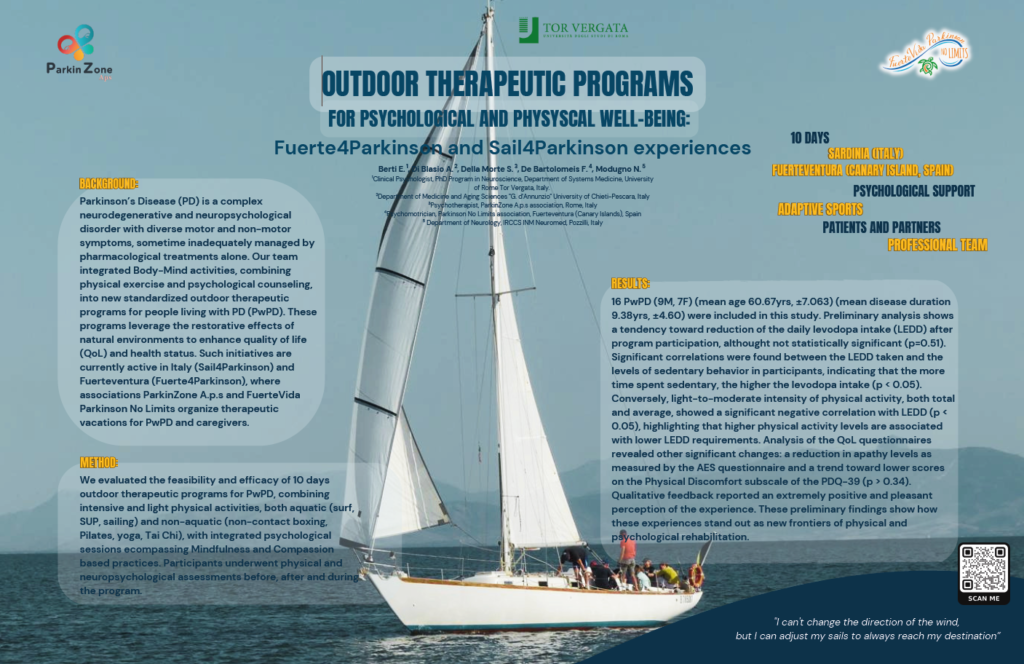
The preliminary results obtained solely from the analysis of the last two experiences conducted this year demonstrate the feasibility and efficacy of the protocol. In total, 16 people with PD (9 males, 7 females) with a mean age of 60.67 years (±7.063) and a mean disease duration of 9.38 years (±4.60) were included in this study.
- Medication (LEDD) and Physical Activity: Preliminary analysis shows a tendency toward reduction in daily levodopa intake (LEDD) after program participation, although not statistically significant (p=0.51). Significant correlations were found between the LEDD taken and the levels of sedentary behavior in participants, indicating that the more time spent sedentary, the higher the levodopa intake (p < 0.05). Conversely, light-to-moderate intensity of physical activity showed a significant negative correlation with LEDD (p < 0.05), highlighting that higher physical activity levels are associated with lower LEDD requirements.
- Quality of Life (QoL): Analysis of the QoL questionnaires revealed other significant changes: a reduction in apathy levels as measured by the AES questionnaire and a trend toward lower scores on the Physical Discomfort subscale of the PDQ-39 (p > 0.34).
- Participant Feedback: Qualitative feedback reported an extremely positive and pleasant perception of the experience.
More detailed analyses, conducted by a larger research team, have been submitted to the scientific journal Sport Sciences for Health and are currently under review for forthcoming publication. These preliminary findings show how these experiences stand out as new frontiers of physical and psychological rehabilitation.
Poster presented at the World Parkinson Congress in Phoenix (WPC2026)